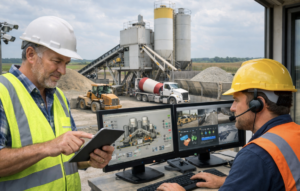
Concrete production has always been about timing, precision, logistics, and trust. In Iowa, where infrastructure, commercial development, agriculture, hospitality, and public works all depend on reliable material supply, batching plants are under constant pressure to deliver the right mix at the right time without costly slowdowns. That is exactly why smarter IT solutions matter so much. When Iowa Concrete Batching Plants adopt stronger software systems, better connectivity, cleaner data flow, and more secure digital operations, they gain more than convenience. They gain visibility, consistency, faster decision-making, and a stronger position in a competitive market. Iowa’s own tech environment is also pushing in this direction, with statewide emphasis on AI, cybersecurity, data privacy, and modern digital infrastructure.
Why IT Matters More Inside a Concrete Plant Than Ever Before
A batching plant is not just a production yard. It is a moving operation with scheduling demands, fleet coordination, quality control standards, maintenance needs, inventory tracking, customer communication, invoicing, and compliance responsibilities all happening at once. When too much of that work is handled through disconnected spreadsheets, handwritten notes, phone calls, and memory, the business becomes harder to manage as volume increases.
Smarter IT solutions help remove friction from that environment. A plant manager can see batch activity in real time. Dispatch can coordinate drivers with fewer delays. Office staff can verify tickets faster. Sales teams can communicate delivery expectations more clearly. Owners can make decisions from actual numbers instead of guesswork. What this creates is not just efficiency on paper. It creates a plant that feels more stable, more responsive, and more ready for growth.
How Iowa’s Technology Climate Supports Better Plant Operations
Iowa is not standing still when it comes to technology. The state’s Information Technology division under the Department of Management oversees core state IT and emphasizes accountability, service standards, and cybersecurity. At the same time, the Technology Association of Iowa’s 2026 policy priorities put artificial intelligence, cybersecurity, data privacy, workforce readiness, and broader digital opportunity at the center of the conversation. That matters because it shows the wider Iowa business climate is already thinking in terms of connected systems, secure operations, and smarter data use.
That broader climate benefits industrial operators too. A concrete batching plant does not need trendy technology for the sake of appearances. It needs practical systems that keep orders moving, reduce confusion, support staff, and protect margins. When the surrounding business environment is increasingly focused on digital modernization, plants that invest in IT are not moving off course. They are moving in step with where Iowa’s operational standards are already heading.
The Real-World IT Tools That Make a Concrete Plant Stronger
The best IT improvements in a batching plant are the ones that solve daily problems without making the operation more complicated. Modern batching software can tie together order entry, mix design data, dispatch schedules, and ticketing. Fleet and GPS tools can reduce delivery uncertainty and help the office answer customers with more confidence. Inventory tracking systems can show cement, aggregate, additive, and admixture usage more clearly so purchasing becomes more accurate.
Maintenance technology also makes a major difference. Instead of waiting for a failure to stop production, plants can use digital maintenance logs, alerts, and service scheduling to catch equipment issues earlier. That matters in a business where downtime affects not just one machine but an entire chain of deliveries, crews, and customer expectations.
Document management is another overlooked benefit. Quotes, mix records, load tickets, service logs, compliance documents, and billing records become easier to access when they live inside a clean digital system instead of being scattered across desks, inboxes, and filing cabinets. Better retrieval means less time wasted, fewer errors, and a more professional customer experience.
Connectivity Is No Longer Optional
None of these improvements work well without reliable connectivity. That is one reason Iowa’s investment in digital infrastructure matters. The Department of Management’s broadband programs are aimed at improving high-speed internet access in underserved areas, and the state’s Dig Once approach is designed to create opportunities to install fiber conduit during infrastructure work. For industrial businesses in and around smaller communities, that kind of digital groundwork matters because stronger connectivity supports cloud systems, remote monitoring, dispatch visibility, and secure communication between the plant, office, and field.
The Iowa Communications Network is another piece of that story. It is a long-standing state-administered fiber network that connects government, education, healthcare, and other public institutions across Iowa. Even though a batching plant may not operate on that network directly, the existence of major statewide fiber infrastructure reflects a business environment that increasingly depends on dependable bandwidth, resilient routing, and modern communications capacity.
Cybersecurity Protects Production, Not Just Computers
Many industrial businesses still think of cybersecurity as something that only matters to banks, healthcare providers, or big corporations. That is a mistake. Concrete operations now rely on email, digital quoting, vendor portals, accounting systems, cloud storage, dispatch platforms, and connected equipment. A cyber incident can interrupt payroll, invoicing, scheduling, customer communication, and even plant uptime.
Iowa’s state technology leadership has been direct about the importance of cybersecurity. The state’s IT and information security functions emphasize protecting networks and systems because Iowa’s economy is increasingly technology-reliant. The state has also highlighted infrastructure upgrades that improve visibility into network traffic and strengthen protection against threats. For batching plants, the lesson is simple: stronger security is part of operational reliability. It is not separate from production.
That point becomes even clearer when you look at recent Iowa network upgrades. The ICN’s DDoS mitigation improvement with Optical TAPs increased network visibility and expanded support for much faster connections, while the ICN’s northern Iowa fiber upgrades added dedicated 10Gb connections and redundancy to keep critical services running. A concrete plant can take the same mindset: build systems that are visible, resilient, and prepared for failure points before they become emergencies.
Better IT Leads to Better Customer Confidence
Customers do not usually ask a batching plant what software it uses. They notice the results instead. They notice whether quotes are clear, whether orders are confirmed correctly, whether deliveries are predictable, whether billing is accurate, and whether communication feels organized. Good IT strengthens all of that.
A contractor waiting on concrete does not care whether a delay came from a bad paper trail, missed call, disconnected spreadsheet, or untracked schedule conflict. They just know the job got harder. Smarter IT reduces those invisible failures. It helps the plant look more dependable because the operation actually is more dependable.
This is where trust grows. Not from flashy promises, but from smoother performance. A plant that uses connected systems can often respond faster, document better, and recover from problems with less chaos. Over time, that shapes reputation, repeat business, and referral value in a meaningful way.
Modernization Also Helps Plants Scale Without Losing Control
Growth can strain a concrete business fast. More jobs mean more tickets, more calls, more routes, more invoices, more maintenance, and more chances for something to slip. Without strong IT, growth can create disorder instead of profit. With strong IT, growth becomes more manageable because the business gains structure alongside volume.
Iowa has already shown what modernization can do on the public side. The Iowa Department of Revenue’s technology modernization program consolidated 22 legacy systems into one integrated platform and expanded secure online services for users across the state. The scale is different, but the principle is the same for a batching plant: when too many disconnected systems are replaced by one clearer operating environment, the business becomes easier to run and easier to serve through.
That same modernization mindset is visible across Iowa’s tech leadership culture more broadly. The Technology Association of Iowa’s GovTech spotlight emphasizes digital innovation, data-driven solutions, modern infrastructure, efficiency, and security in public service environments. Concrete businesses may operate in a different lane, but the operational lesson still carries over: smarter systems create stronger performance.
Conclusion
Smarter IT solutions are not a luxury for today’s concrete producers. They are a practical advantage. For Iowa batching plants, better software, better connectivity, stronger cybersecurity, cleaner workflows, and more integrated data systems can reduce waste, improve scheduling, strengthen customer service, and support growth without the usual chaos that expansion can bring.
The most successful plants are not just producing quality concrete. They are building quality operations behind the scenes. They understand that every load depends on coordination, every delay has a cost, and every preventable mistake chips away at trust. In that kind of environment, smarter IT is not extra. It is part of what keeps the plant accurate, reliable, competitive, and ready for what comes next.